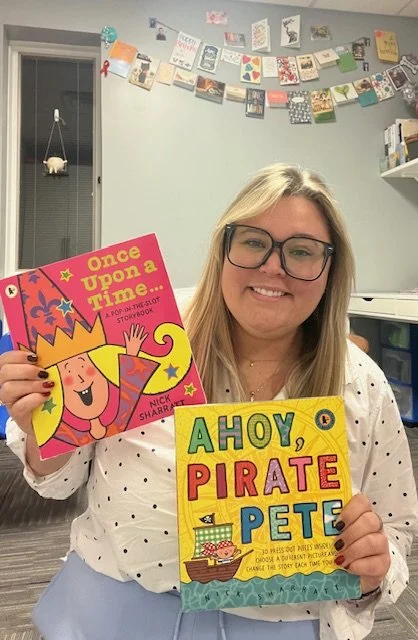
Reading to your child is about so much more than enjoying a good story together! Storytime is one of the easiest and most meaningful ways to support your child's speech, language, and communication development. Whether you're reading to a baby, a busy toddler, or a preschooler, sharing books provides opportunities to build vocabulary, practice listening skills, encourage interaction, and develop the foundations for communication.
The best part? You don't need to be a professional storyteller or read every word on the page. Simply looking at pictures, making silly sounds, asking questions, and talking about what you see can turn reading time into a valuable language-learning experience.
If you're looking to build your child's home library, here are some of our favorite types of books that encourage foundational speech and language skills, along with ways to use them during storytime!
1. Books With Repetitive Phrases
Great for: Early language development, imitation, predicting, and building confidence with new words.
Books with predictable, repetitive phrases give children the opportunity to hear the same words and sentence structures over and over again. As children become familiar with the story, they may begin anticipating what comes next, filling in missing words, or repeating favorite phrases.
Books to try:
Brown Bear, Brown Bear, What Do You See? by Bill Martin Jr. and Eric Carle
The Very Hungry Caterpillar by Eric Carle
We're Going on a Bear Hunt by Michael Rosen
Speech therapist tip: Pause before a familiar word or phrase and give your child a chance to fill in the blank. If you read, "Brown bear, brown bear, what do you..." pause and see if your child attempts to say "see!" Even a gesture, sound, or excited look is a meaningful way to participate.
2. Books With Animal Sounds and Fun Noises
Great for: Sound imitation, early vocalizations, turn-taking, and developing verbal communication.
Animal sounds and environmental noises are often some of the first sounds children imitate. Books featuring animals, vehicles, and everyday sounds make it fun to experiment with making sounds together. These playful sounds can help children practice using their voices and engaging in back-and-forth interactions.
Books to try:
Moo, Baa, La La La! by Sandra Boynton
Dear Zoo by Rod Campbell
Noisy Farm by Rod Campbell
Speech therapist tip: Don't just read the words! Make the animal sounds together. Try "Moo!" for a cow, "Woof!" for a dog, or "Vroom!" for a car. Pause to give your child time to imitate you. Remember, attempts at sounds count, too!
3. Books That Introduce Everyday Vocabulary
Great for: Learning new words, identifying objects, understanding language, and building expressive vocabulary.
Children learn language by connecting words with the people, objects, and experiences around them. Picture books featuring familiar items like food, clothing, toys, animals, and household objects are wonderful tools for introducing new vocabulary.
Books to try:
First 100 Words by Roger Priddy
My First Words by DK
Goodnight Moon by Margaret Wise Brown
Speech therapist tip: Talk about what you see on each page. Label objects, describe their colors and functions, and connect pictures to things your child encounters in everyday life. Instead of only asking, "What's that?" try modeling language like, "Look! A big red ball. The ball is bouncing!"
4. Books That Encourage Action Words
Great for: Expanding vocabulary, understanding directions, and developing early sentence structure.
Nouns (people, places, and things) are important, but action words, also called verbs, are just as essential! Words like run, jump, eat, sleep, wash, and play help children describe what is happening around them and eventually communicate more complex ideas.
Books to try:
From Head to Toe by Eric Carle
The Going-To-Bed Book by Sandra Boynton
We're Going on a Bear Hunt by Michael Rosen
Speech therapist tip: Act out the actions as you read! If a character is jumping, encourage your child to jump, too. Model simple phrases such as "Bear runs," "Baby sleeps," or "Let's jump!" Pairing words with movement helps make language meaningful.
5. Books That Encourage Interaction and Turn-Taking
Great for: Joint attention, social communication, listening, and back-and-forth interactions.
Communication is about more than talking. Learning to share attention, take turns, respond to others, and participate in interactions are all foundational communication skills. Interactive books with flaps, textures, surprises, or opportunities to make choices can help children practice these important skills.
Books to try:
Where's Spot? by Eric Hill
Press Here by Hervé Tullet
Don't Push the Button! by Bill Cotter
Speech therapist tip: Give your child opportunities to take the lead. Let them turn the pages, point to pictures, lift flaps, or choose which page to read next. Pause and wait for their response before moving on. Communication can look like pointing, reaching, making a sound, using a word, or looking toward something!
6. Books That Encourage Describing and Answering Questions
Great for: Building longer phrases, comprehension, describing, and early conversation skills.
As children grow, books can help them move beyond naming objects and begin describing what they see, answering questions, and talking about events. Stories with colorful illustrations and engaging characters create opportunities to discuss what is happening and make connections.
Books to try:
The Snowy Day by Ezra Jack Keats
A Sick Day for Amos McGee by Philip C. Stead
If You Give a Mouse a Cookie by Laura Numeroff
Speech therapist tip: Ask questions that encourage your child to think and communicate. Try questions like "What is he doing?", "Where did the mouse go?", or "How do you think she feels?" For younger children, model the answer rather than expecting them to respond independently. For example, if you ask, "What is the dog doing?" you can follow up with "He's running!"
Making the Most of Storytime: 5 Tips From Our Speech Therapists
You don't need to read an entire book from beginning to end to support your child's communication development. Try these simple strategies to make storytime more interactive:
Follow your child's lead. If your child loves a particular page, spend extra time exploring it. You don't have to follow the story exactly as written.
Talk more than you quiz. Instead of constantly asking, "What's that?" model words and phrases by describing what you see. Children benefit from hearing language used naturally.
Expand on what your child says. If your child says "dog," you can respond with "Yes! A big dog!" If they say "doggy run," try "The doggy is running!" This helps introduce new words and longer phrases.
Pause and give them time. Children need time to process language and formulate a response. After modeling a word or asking a question, wait a few seconds before jumping in.
Make it fun! Use silly voices, exaggerated expressions, gestures, sounds, and movement. The more enjoyable the experience, the more likely your child will want to participate.
Remember: Every Child Communicates Differently!
One of the most important things to remember is that reading together should never feel like a test. Your goal isn't to get your child to repeat every word or answer every question correctly. Instead, focus on creating positive opportunities for connection, interaction, and communication.
Some children may participate by pointing to pictures, making sounds, turning pages, or using gestures. Others may begin naming objects, repeating phrases, or telling you about the story. All of these are opportunities to build communication skills!
If you have concerns about your child's speech or language development, an evaluation with one of our speech-language pathologists can help determine whether additional support may be beneficial. Call us at 724-888-2548 to schedule an evaluation today!
At Reach for Speech, we believe that small moments throughout the day can make a big difference in your child's development. So, grab a favorite book, get cozy, and enjoy some story time together. You're building more than a love of reading, you're building the foundation for Speech and Language!